Yeh lines sirf borders nahi hain — yeh debt flows hain jo garib deshon ko garib rakhte hain.
Garib desh garib rehte hain — yeh sirf unki kismat nahi hai, yeh ek carefully designed system hai. Aur isko samajhna bahut zaroori hai — kyunki India ka naam bhi kabhi kabhi is list mein aata hai.
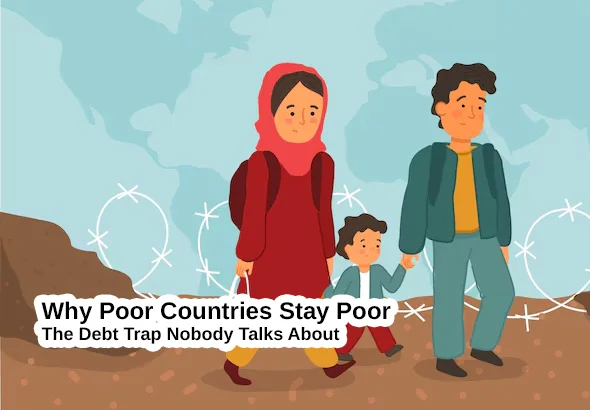
Garib desh garib isliye rehte hain kyunki woh ek structural debt cycle mein phanse hote hain — jahan loan lene ke conditions unki economy ko repair nahi karne dete, balki dependent banaye rakhte hain. IMF aur World Bank ke Structural Adjustment Programs (SAPs) historically garib deshon ki government spending cut karwaate hain — education, health, aur infrastructure mein — jo poverty aur badh jaati hai.
Pehle Yeh Samjho — Garib Desh Garib Rehta Kyun Hai?
Ek simple question hai jo school mein kabhi nahi poochha jaata: agar koi desh itna garib hai toh woh loan kaise chukayega? Yeh question hi poverty trap ka door kholta hai.
Sochte hain ek developing country ke baare mein — nahin, koi specific country nahi, ek hypothetical lekin realistic example. Is desh mein natural resources hain — shayad oil, minerals, ya fertile land. Lekin infrastructure nahi. Roads nahi. Hospitals nahi. Schools nahi. Foreign investment ke liye stable currency nahi.
Toh woh desh loan leta hai. International organizations se. Terms hote hain — hamesha terms hote hain.
The Poverty Trap — What Economics Textbooks Miss
Poverty trap woh situation hai jahan ek desh itna garib hai ki woh apni economy grow karne ke liye zaroorat ki cheezein afford nahi kar sakta — aur yeh inability hi usse aur garib banati rehti hai. Circular problem hai.
Ek mota sa anumaan: agar aap ek din mein sirf ₹200 kamate hain, toh aap savings nahi kar sakte. Aur bina savings ke, aap investment nahi kar sakte. Aur bina investment ke, income nahi badhti. Yahi logic national level pe apply hota hai — billions ki scale pe.
Lekin poverty trap sirf economic hota nahi. Iske saath aata hai institutional weakness — corrupt governments, weak legal systems, unreliable judiciary. Aur yeh sab milke ek environment banate hain jahan foreign investment risky lagta hai aur domestic entrepreneurs safe nahi feel karte.
Debt Trap Kaise Kaam Karta Hai — Step by Step
Debt trap ka mechanism samajhne ke liye ek practical example dekho. Ek African desh — Ghana ko lelo, jo actually ek real example hai.
Ghana ko 1957 mein independence mila. Resources the — cocoa, gold. Lekin colonial era mein economy design ki gayi thi raw materials export karne ke liye, finished goods import karne ke liye. Independence ke baad bhi yeh structure wahi raha.
Infrastructure build karne ke liye loans liye gaye. Phir commodity prices girein — cocoa aur gold ke rates international markets pe crash kiye. Export revenues kam hue. Loan repayments mushkil ho gayi. Aur phir IMF aaya.
How Structural Adjustment Programs Actually Work
- Government spending cuts:
Education, healthcare, aur public services ke budgets reduce karo. Fiscal discipline ke naam pe. - Privatization:
State-owned utilities, banks, aur services ko private companies ko becho — often foreign companies ko. - Trade liberalization:
Import tariffs hatao — jisse local industries foreign competition se protect nahi ho paati aur domestic manufacturing struggle karti hai. - Currency devaluation:
Exports saste bano — lekin import costs badh jaati hain, inflation aati hai, purchasing power girta hai. - Interest rate hike:
Inflation control ke liye — lekin local businesses ke liye loans expensive ho jaate hain, growth slow hoti hai.
In conditions ka combined effect? Economy short-term mein aur contract karti hai. Unemployment badhta hai. Poverty badhti hai. Aur woh desh agle loan ke liye wapas IMF ke paas jaata hai — zyada desperate conditions ke saath.
IMF Aur World Bank Ka Role — Savior Ya Jailor?
Yeh ek bahut nuanced question hai aur honest jawab yeh hai: dono thoda thoda.
IMF aur World Bank genuinely crisis mein deshon ko immediate liquidity provide karte hain. Bina unke, kuch desh complete economic collapse face karte. Argentina 2001, Greece 2010, Sri Lanka 2022 — inhe IMF bailouts ne immediate collapse se bachaya.
Lekin conditions ka criticism valid hai. Joseph Stiglitz — Nobel Prize winning economist aur World Bank ke ex-Chief Economist — ne openly kaha hai ki SAPs ne developing countries ko “jump-start” karne ki jagah “stall” kar diya. Yeh koi conspiracy theory nahi — yeh academic economic consensus ka ek significant part hai.
Problem yeh hai ki IMF ki governance structure mein voting power GDP ke proportional hai. Matlab US ka vote Ghana ke vote se incomparably zyada powerful hai. Conditions jo Western economies ke liye theek hain — woh developing economies ke liye devastating ho sakti hain jahan social safety nets exist nahi karte.
Ek aur angle: odious debt ka concept. Agar ek corrupt dictator apne desh ke liye loan leta hai aur paise khud rakh leta hai — toh kya woh desh ki population responsible hai us loan ko chukane ke liye? International law kehta hai haan. Ethics kehti hai shayad nahi.
China Ka Debt Trap — Kya Yeh Alag Hai?
Pichle decade mein ek naya player aaya hai — China. Belt and Road Initiative (BRI) ke through China ne developing deshon ko infrastructure loans diye hain — ports, roads, railways, power plants.
Critics ne ise debt-trap diplomacy kaha — jahan China deliberately zyada loan deta hai jaan’ke ki desh repay nahi kar payega, phir strategic assets le leta hai repayment ke badla mein. Hambantota Port in Sri Lanka — China ko 99 saal ke lease pe mila — yeh sabse cited example hai.
Lekin researchers ka ek significant group is narrative se disagree karta hai. Deborah Brautigam — Johns Hopkins University — ka research kehta hai ki “debt-trap diplomacy” ek oversimplification hai. China ne rarely assets seize kiye hain. Real picture zyada complex hai — kuch deals corrupt local politicians ne facilitate kiye, kuch genuinely development-oriented hain. Nuance zaroori hai.
Jo clear hai woh yeh hai ki both Western-led institutions aur China — dono ke loans ke saath significant strings attached hain. Koi free lunch nahi hota sovereign finance mein.
India Is Sab Mein Kahan Hai?
India ki story interesting hai kyunki yeh ek partial escape ki kahani hai — aur partially ek warning bhi.
India ne 1991 mein IMF ka bailout liya — aur saath mein structural adjustment conditions bhi. Liberalization usi time shuru hua. Critics kehte hain liberalization impose ki gayi, proponents kehte hain yeh zaroorat thi. Dono mein truth hai.
Aaj India ka external debt approximately $624 billion hai — aur as a percentage of GDP yeh manageable range mein hai (~18%). Lekin state-level fiscal situations alag hain. Kuch states chronic debt distress mein hain.
India ka important advantage yeh hai ki domestic savings rate historically high raha hai — matlab India apni development internally fund kar sakta hai relatively zyada. Yeh woh luxury hai jo sub-Saharan African economies ke paas nahi hai.
Kya Koi Rasta Hai Bahar Nikalne Ka?
Haan — lekin woh simple nahi hai aur koi ek formula nahi hai. Jo desh debt trap se nikle hain unka study karein toh kuch patterns milte hain:
- Domestic resource mobilization:
Tax collection improve karna — especially corporate aur wealth taxes. Kenya, Rwanda ne yeh kiya successfully. Corruption reduce karna taki tax revenue actually government tak pahunche. - Industrial policy:
South Korea, Taiwan, aur China ne active industrial policy use ki — specific sectors support kiye, foreign competition se protect kiya jab tak domestic industries competitive nahi hui. “Free trade” sab ke liye always optimal nahi hoti. - Debt restructuring negotiation:
Zambia, Sri Lanka, Ghana — teen recent cases hain jahan debt restructuring negotiations successfully complete hue. Painful lekin necessary. - Regional cooperation:
African countries ka AfCFTA (African Continental Free Trade Area) — ek promising development. Ek doosre se trade badhana, external dependence kam karna. - Governance reform:
Boring lagta hai lekin most critical hai. Singapore, Botswana — resource-poor ya resource-rich dono cases mein governance quality ne difference banaya.
Koi magic solution nahi hai. Lekin yeh clearly samajhna ki problem structural hai — sirf “culture” ya “corruption” nahi — yeh pehla step hai. Aur yeh samajhna ki India ke liye bhi yeh lessons relevant hain — kyunki development ka koi guaranteed path nahi hota.
Aapki Kya Soch Hai?
Comment mein batao — kya aapko lagta hai IMF aur World Bank genuinely help karte hain ya system perpetuate karte hain? Aur India ke baare mein — kya humari economic independence secure hai? Yeh post apne us dost ko share karo jo economics mein interested hai.
Related:
Why the US Dollar May Not Be Reserve Currency in 2040 (Day 30 Post 2) →
How Hedge Funds Bet Against Countries (Day 35 Post 1) →
The Invisible Tax Most Salary Earners Never Notice (Day 7 Post 1) →
About the Author