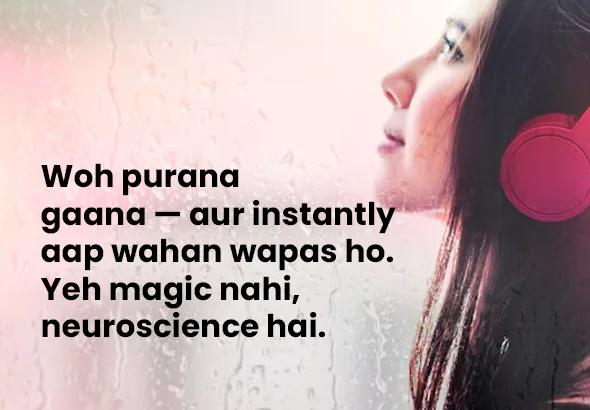
Woh purana gaana — aur instantly aap wahan wapas ho. Yeh magic nahi, neuroscience hai.
Koi bhi 90s ka dard bhara Bollywood gaana sunao — aur suddenly aap 15 saal peeche hain, ek specific moment mein, ek specific feeling ke saath. Yeh magic nahi hai. Yeh neuroscience hai. Aur samajhna genuinely interesting hai.
Sad songs zyada yaad rehte hain kyunki emotional arousal memory encoding ko enhance karta hai. Sadness, nostalgia, aur longing — yeh emotions amygdala ko activate karte hain jo hippocampus ke saath milke memory ko “important” tag karta hai aur long-term storage mein prioritize karta hai. Happy songs less emotionally intense hote hain — isliye brain unhe “mundane” categorize karta hai aur woh fade ho jaate hain.
Woh Purana Gaana — Aur Sirf Woh Hi Kyun Yaad Rehta Hai?
Ek simple test karo. Abhi — in 10 seconds — ek happy party song yaad karo jo aapne last 5 saalon mein suna ho. Aur phir ek sad ya emotional song jo aapne same period mein suna ho.
Galti se bet laga sakte hain ki sad song ke saath ek specific memory bhi aayi — kahan tha, kiske saath, kya feel hua. Happy song ke saath? Shayad sirf song yaad aaya, memory nahi.
Yeh coincidence nahi hai. Yeh aapka brain systematically alag tarike se kaam kar raha hai — aur researchers ne last 20 saalon mein samjha hai kyun.
How Memory Encoding Actually Works
Memory ek recording nahi hai — yeh ek reconstruction hai. Har baar jab aap kuch yaad karte ho, brain woh memory dobara build karta hai — available pieces se. Isliye memories time ke saath change hoti hain.
Lekin yeh reconstruction better hoti hai jab original encoding stronger tha. Aur encoding strength directly linked hai ek cheez se: emotional arousal at the time of experience.
James McGaugh — UC Irvine ke neuroscientist — ne 1990s mein demonstrate kiya ki emotional arousal ke time release hone wala adrenaline directly hippocampus ko signal bhejta hai: “Yeh moment important hai — ise store karo.” Jitna zyada arousal, utni stronger memory tag.
Amygdala Ka Role — Emotion Aur Memory Ka Secret Connection
Brain mein do structures hain jo is poori story ke heroes hain: amygdala aur hippocampus. Dono temporal lobe mein side by side hain — aur woh constantly communicate karte hain.
Amygdala emotional processing ka center hai — especially fear, sadness, aur threat detection. Hippocampus memory formation ka center hai. Jab amygdala highly activated hota hai — kisi strong emotion se — woh hippocampus ko essentially “overdrive mode” mein daal deta hai.
Iska evolutionary reason simple hai. Agar kuch emotionally intense hai — threat, loss, extreme joy — toh usse yaad rakhna survival ke liye important hai. Kahan sher tha. Kahan food tha. Kab yeh cheez dard deti thi. Emotion = importance signal = remember this.
Interesting flip side: stress hormones (cortisol) long-term mein memory ko actually impair karte hain. Isliye chronic stress mein memory poor hoti hai. Lekin acute emotional arousal — short, intense feeling — memory ko enhance karta hai. Sad song suno = acute emotional response = stronger encoding. Chronic sad rehna = poor memory. Yeh distinction important hai.
Music Brain Ko Kaise Hit Karta Hai — Other Stimuli Se Alag
Music baaki sensory inputs se fundamentally alag hai is ek reason ki wajah se: woh simultaneously multiple brain areas activate karta hai — jo normally saath kaam nahi karte.
- Auditory cortex: Sound processing — obvious
- Motor cortex: Rhythm ke response mein — isliye involuntarily foot tap hoti hai
- Limbic system: Emotional processing — amygdala, nucleus accumbens
- Prefrontal cortex: Expectations aur anticipation — “yeh next line kya hogi?”
- Hippocampus: Memory retrieval — associated memories automatically surface
- Cerebellum: Timing aur rhythm prediction
Koi aur stimulus yeh sab ek saath nahi karta — na smell, na visual, na taste. Music brain ka most complete activator hai. Aur jab itne saare areas simultaneously active hote hain — memory formation natural byproduct hoti hai.
The EAMC Model — Emotion, Attention, Memory, Consolidation
Researchers ne music-memory connection ke liye EAMC model propose kiya hai:
E — Emotion:
Song emotional response trigger karta hai. Sad song sadness, nostalgia, longing trigger karta hai — intense emotions jo amygdala highly activate karte hain.
A — Attention:
Emotional arousal attention narrow karta hai — aap song aur us moment ke details pe zyada focused ho jaate ho. Distractions reduce hoti hain.
M — Memory:
High attention + high emotional arousal = strong encoding. Hippocampus is combination ko priority deta hai.
C — Consolidation:
Sleep ke during yeh memories consolidate hoti hain — permanently long-term storage mein. Isliye kal ki party ka gaana fade ho jaata hai, 10 saal pehle ke breakup ka gaana nahi.
Sad Song Specifically Kyun — Happy Song Kyun Nahi?
Yeh legitimate question hai. Happy songs bhi emotions trigger karte hain — toh happy song itna memorable kyun nahi hota?
Two reasons:
Pehla — intensity difference. Happiness ek diffuse, generalized emotion hai. Sadness, nostalgia, aur longing — yeh pinpoint, specific emotions hain. Amygdala pinpoint emotions ko zyada strongly respond karta hai. Sad songs create karte hain specific emotional “texture” jo unique hoti hai aur therefore more distinctly encoded hoti hai.
Doosra — rumination effect. Sad song sunne ke baad hum us song ke baare mein sochte rehte hain — lyrics, melody, associated memory. Yeh post-exposure processing memory ko aur strengthen karta hai. Happy song ke baad hum next happy cheez ki taraf move on karte hain — processing stop ho jaati hai.
Paradox of sad music: research ne show kiya hai ki log sad music isliye nahi sunte ki aur zyada sad ho sakein — balki isliye ki woh safe distance se complex emotions experience karna chahte hain. “Benign masochism” kehte hain ise — intentionally negative experience choose karna knowing that you’re safe. Sad song ek controlled emotional workout hai.
Hindi Music Aur Nostalgia — Ek Special Case
Hindi film music ke context mein yeh sab bahut relevant ho jaata hai — kyunki Bollywood songs uniquely designed hote hain emotional impact ke liye.
Ek average Bollywood sad song mein hota hai: minor keys (neurologically linked to sadness), slow tempo (heart rate slow hone ki physiological response mimics sadness), specific lyrical themes jo universal experiences tap karte hain — separation, longing, loss, unfulfilled love. Yeh combination deliberately engineered emotional response create karta hai.
Aur phir woh songs specific life moments ke saath pair ho jaate hain — first heartbreak, college hostel ki raat, kisi ke jaane ka time. Reminiscence bump — 15 se 25 saal ki age mein experienced music sabse strongly remembered hoti hai kyunki woh period maximum identity formation ka hota hai. Isliye 90s Bollywood ke gaane unhe sunn ke itna overwhelming feel hota hai jo us time teenagers the.
Researchers iska ek interesting application bhi dhundh rahe hain: Alzheimer’s patients — jinki memory significantly impaired hoti hai — often apni youth ki music perfectly recall kar sakte hain. Emotional memory aur musical memory kuch alag pathways use karte hain jo Alzheimer’s se less affected hote hain. Is discovery pe therapeutic music programs build ho rahe hain globally.
Kya Yeh Aapke Liye Kuch Kaam Ka Hai?
Ek practical implication: agar aap kuch important yaad rakhna chahte hain — study material, koi experience, koi lesson — usse emotionally charge karo.
- Music ke saath study karo — lekin sahi music:
Instrumental music (no lyrics) background mein emotions mildly activate karta hai bina distraction ke. Classical ya film instrumentals ideal hain study ke liye. - Emotional associations banao:
Jo bhi yaad rakhna hai usse ek personal emotion ya memory se link karo. Abstract concepts emotionally tagged ho jaate hain toh better stick karte hain. - Nostalgia strategically use karo:
Jab mood low ho — nostalgic music suno. Research show karta hai ki nostalgia meaning-making facilitate karta hai aur actually mood improve karta hai. - Sleep before and after:
Important experience ke baad acchi neend lo — consolidation tab hoti hai. Aur important study ke ek din pehle bhi — sleep memory encoding prime karta hai.
Aur agar koi purana sad song suddenly aapko overwhelm karta hai — woh weakness nahi hai. Woh aapka brain ek perfectly engineered memory system use kar raha hai jo millions of years of evolution ne develop kiya hai. Yeh sab exactly as designed hai.
Kaunsa Gaana Hai Jo Aapko Instantly Kisi Memory Mein Le Jaata Hai?
Comment mein share karo — woh gaana aur woh memory. Aur yeh post apne us dost ko bhejo jo kehta hai “main kisi purane gaane ko kyun nahi bhool paata” — kyunki ab scientific jawab hai. 👇
Related:
Why You Feel Tired After Doing Nothing →
Why Nostalgia Is Scientifically Good for You (Day 58 Post 1) →
The Reason You Can’t Remember Being 3 Years Old (Day 15 Post 1) →
About the Author